
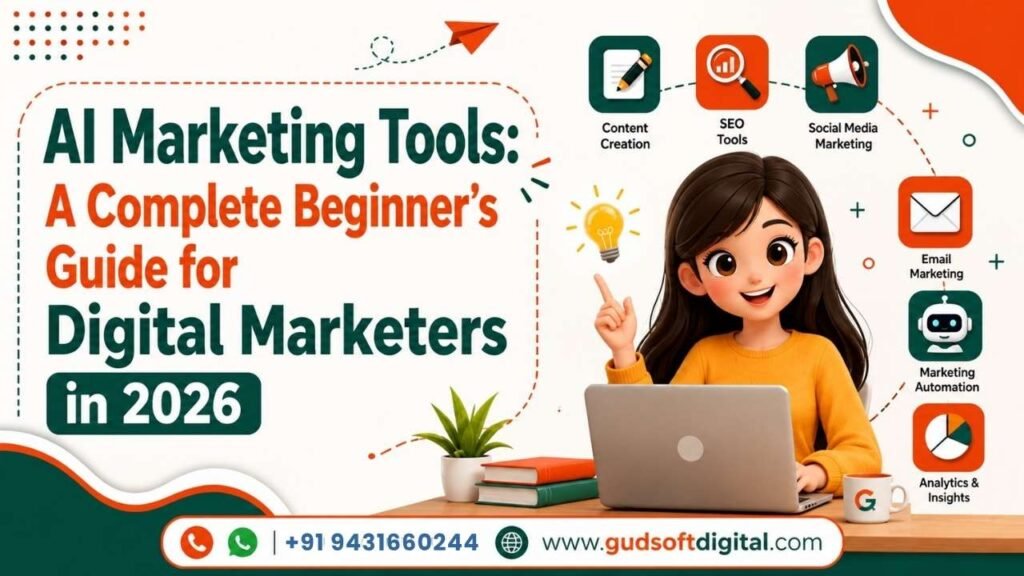
In 2026, digital marketing seems to get faster and a bit more clever, and honestly, it feels like everything is moving at once. AI marketing tools help people create content, do keyword research, keep an eye on social media, interpret customers, and also automate the repetitive chores that nobody really wants to touch. For beginners or small companies, these tools can be a major time saver, and they make daily marketing work feel lighter even if you’re juggling a dozen other things at the same time.
AI does not mean that marketers are no longer needed. Instead, it works like an assistant. The marketer still needs to understand the audience, check the content, add creativity, and make the final decisions.
What Are AI Marketing Tools?
AI marketing tools are basically software platforms that rely on artificial intelligence to assist with a bunch of marketing activities. They can take a look at data, suggest new angles, generate content, handle routine tasks automatically, and offer useful insights that you can actually use.
For example, a digital marketer can use AI to draft a social media caption, dig for content ideas, put together an email, or dig into keyword research. And instead of starting each task from zero, AI gives a useful jump-off point, like it’s already got the first steps laid out for you.
Traditional marketing software is usually kind of stuck to set commands or routines. With AI-driven tools though they can take in what you’re asking, look at the patterns in the data, then craft replies from what’s given, kinda.
Why Are AI Marketing Tools Important in 2026?
Digital marketers do a ton of tasks every day. They might be juggling SEO, blog posts, social media, emails, advertisements, customer dialogue, plus the reports part too. If all of it is done manually, it can take a tremendous amount of time, you know. Like really, the hours add up quickly and it gets kinda messy.
This is where AI Tools for Digital Marketing kinda help, a lot. They can make the repetitive work faster, and let marketers focus on strategy and creativity, more. Also it feels like a smoother flow overall, without so much dull effort.
Some common benefits include:
- Faster content creation
- Easy keyword and topic research
- Social media content planning
- Marketing task automation
- Customer data analysis
- Better campaign planning
- Quick ideas for emails and advertisements
Like, a local restaurant might use AI to come up with ideas for a weekend deal, sketch out some Instagram caption drafts, think up Google Business Profile post suggestions, and even write promotional pieces. Then the owner , or the marketer ,can look it over and personalise the finished stuff before it goes live.
Types of AI Marketing Tools
Different marketing tasks require different types of AI tools.
1. AI Content Writing Tools
These tools help marketers churn out blog ideas, captions , email drafts, product descriptions, and a bunch of other marketing content. They come in handy when you need concepts fast, but the final output really should be reviewed and tweaked each time, because it usually benefits from a quick edit .
2. AI SEO Tools
AI tools for SEO can really help with keyword finding, content fine tuning, competitor spotting, and overall SEO strategy. They often make the research part feel easier, but the rankings , still come down to how good the content is, whether it matches search intent, how strong the site authority is, and a whole bunch of other connected variables too.
3. AI Social Media Tools
AI tools for social media marketing can kind of help with post ideas, caption drafts, content calendars and creative concepts, like the whole thing. Some platforms even offer scheduling features plus performance analysis so you can see what’s working, and what’s kind of not.
4. AI Marketing Automation Tools
These tools are meant to help automate those repetitive things like sending emails, tracking leads, doing customer follow ups, and handling workflow management. It can be particularly handy for marketers that are running several campaigns at once, you know, lot going on in parallel.
5. AI Design and Video Tools
AI-driven design and video tools can help make graphics, presentations, short-form videos, and promotional creatives quicker, like you don’t have to spend days coordinating everything. Theyre especially handy for small businesses that maybe don’t have a big creative team, or not enough people to keep up with the pace of content.
The key thing is pretty simple : use AI to make the whole process feel easier, but still keep human creativity , experience, and judgement right at the center of your marketing strategy, like don’t just let the machines do everything.
Best AI Marketing Tools for Digital Marketers in 2026
There are like many AI Marketing Tools floating around today but each of these tools ends up doing a different job. Some seem helpful for content, while others are better suited for SEO, design, automation, or even customer communication. Really, it depends what you are trying to achieve and how you want to run things, sort of.
Here are some popular options digital marketers can explore:
1. ChatGPT
ChatGPT can kind of help with content ideas, blog outlines, social media captions, emails, ad copy, and also some marketing research. It feels especially handy for beginners, freelancers, and even smaller marketing teams, you know, the ones that move fast.
However, marketers should always check facts and edit generated content before publishing.
2. Google Gemini
Google Gemini can help with brainstorming, research , content organizing, and those everyday marketing things. Marketers can use it to dig up ideas, and kind of make complicated information feel more clear, more manageable.
3. Claude
Claude can be pretty handy for messing around with text , like summarising key stuff , brainstorming directions and even drafting longer form content. It tends to help when marketers have to organise all that big pile of information, or when they want to understand what it really means, in a more steady way .
4. Canva AI
Canva offers AI powered features that can help marketers to craft social media graphics, presentations , promotional creatives, and other kinds of visual content in a way that feels kinda faster, maybe more fluid too.
It’s really quite helpful for small businesses and folks in marketing who want to craft professional-looking visuals without any advanced design know-how, at all , I guess.
5. Semrush
Semrush offers a bunch of tools for SEO, like keyword research, competitor lookouts, content planning, and website evals. And with its AI-driven features it can kind of support marketers as they map out, and later strengthen SEO campaigns, not just guess around.
6. HubSpot AI
HubSpot comes with AI bits for content , sales, customer chats, and marketing automation too. It can be handy if a business wants to steer a bunch of marketing efforts from one single platform, like you know, all in one place.
7. Zapier
Zapier helps connect different apps together, sort of, and then automate the repetitive flows. For instance, marketers can streamline lead details, send notifications, trigger emails, and other everyday activities with just a few steps.
These Best AI Tools for Marketers can save time, but there is no single tool that is perfect for every business. Choose a tool according to your actual marketing needs and budget.
How to Use AI Marketing Tools: Step-by-Step Guide
Using AI does not need to be complicated. Beginners can start with a simple process.
Step 1: Identify Your Goal
Ok so first thing, figure out what you actually want to do there. Like what’s the target, you know creating content, upping SEO a bit, generating leads, running your social presence, or automating the same repetitive chores, over and over.
Step 2: Choose the Right Tool
Pick a tool that actually matches what you’re trying to do. Like , you could use a writing assistant to pull content ideas, and then a design platform for social media graphics, you know. It’s a bit like choosing the right instrument, one for the words, and one for the look.
Step 3: Give Clear Instructions
AI tends to work better if the directions are more specific, not just vague like “make it good”. Tell it who this is for, like your audience, and what kind of business you run, plus what the end goal is. Also say where you’re using it, for example on a website, Instagram, or in an email sequence. If there are other important details, add them too, because otherwise it can get a bit distracted or just wander off.
Step 4: Review the Output
Never publish content that was generated by AI without taking a look at it first, ok? Check the facts too , and don’t forget the grammar—plus the brand tone, if that even matters in your context. Also make sure it’s actually useful for your audience, not just something “sounds right” for a second.
Step 5: Add a Human Touch
Edit the output using your own experience, examples, opinions, and brand voice. This makes marketing content more natural and relevant.
Step 6: Track the Results
After publishing or putting to use the content, check how it performs, sort of. Take a look at traffic, engagement, lead generation, conversions, or other measurable signals tied to your goal . You want to notice what’s working, and what needs tweaks, maybe.
Simple Example
So basically a local clinic wants to push a health check-up package, right. And then AI can sort of help coming up with campaign ideas, write a social media caption, suggest some FAQs too, and even make an email draft, all of that without too much fuss.
The marketer can then verify the information, add the clinic’s actual details, adjust the tone, and publish the final version.
Benefits of AI Marketing Tools
When used correctly, AI can make everyday marketing easier.
Some important benefits are:
- Saves time on repetitive tasks
- Helps generate new content ideas
- Makes marketing research easier
- Supports SEO and social media planning
- Helps small marketing teams work efficiently
- Makes automation easier
- Supports faster data analysis
The biggest benefit is not replacing human work. It is giving marketers more time to focus on creativity, customers, and strategy.
Limitations of AI Marketing Tools
AI is useful, but it is not always accurate. Marketers should understand its limitations before depending on it for important work.
Some common limitations include:
- AI can provide incorrect or outdated information.
- Generated content may sometimes sound generic.
- Human editing and real fact checking still need to happen, even if it feels like it should be self evident.
- Some advanced tools can end up being kinda pricey too, depending on what you choose.
- Also when you share sensitive customer or business data there can be real privacy concerns, not just theoretical ones.
- And if you automate too much, the whole communication can start to feel less personal, like it’s missing that human touch.
The best approach is to use AI Marketing Tools as assistants rather than depending on them for every marketing decision.
Free vs Paid AI Marketing Tools
Many Free AI Marketing Tools or free plans are enough for beginners who want to experiment with AI. They may provide basic content generation, design, research, or automation features.
Paid plans usually offer higher usage limits, advanced features, integrations, team collaboration, and additional capabilities.
If you are just starting, try the available free version first. Upgrade only when the additional features can genuinely support your work or business goals.
How Small Businesses Can Use AI Marketing Tools
AI is not useful only for large companies. AI Tools for Small Business can also help local businesses manage everyday marketing activities.
For example:
- Restaurants: Generate promotional post ideas and captions.
- Clinics: Draft educational content and common FAQs.
- Salons: Create social media content ideas and offer descriptions.
- Local Shops: Prepare product descriptions and promotional messages.
- Coaching Institutes: Generate educational content and campaign ideas.
- Service Providers: Draft emails, blogs, FAQs, and social media posts.
For a small business with a limited marketing team, these tools can reduce the time spent on basic tasks. However, all business details, prices, offers, and important information should be checked before publishing.
AI Marketing Tools vs Human Marketers
A usual question people ask is if AI will replace digital marketers. But honestly in practice, AI and real human marketers are kind of different animals , they work better in different places and with other kinds of strengths.
- AI Can Help With Humans Are Better At
- Repetitive tasks Creative thinking
- Data processing Understanding emotions
- Content ideas Brand strategy
- Automation Customer relationships
- Quick research Final decision-making
AI can process information quickly, but it does not have real-world experience or human judgement.
A marketer kinda gets the whole idea, like why customers act the way they do, which message fits a local audience, and also how the brand is supposed to communicate, not just generally but in a more specific manner.
That is why a practical approach in 2026 is AI + human expertise.
How to Choose the Right AI Marketing Tool
Do not choose a tool simply because it is popular. First, understand what problem you want to solve.
Before selecting a tool, check:
- Your marketing goal
- Features you actually need
- Ease of use
- Free and paid pricing
- Integration with existing tools
- Data privacy
- Customer support
- Usage limits
For example, if your main goal is creating social media graphics, you may not need an expensive SEO platform. Choose according to your actual requirements and budget.
Common Mistakes to Avoid
Beginners sometimes expect AI to handle everything automatically. This can lead to poor-quality marketing.
Avoid these common mistakes:
- Copy-pasting AI content without editing
- Trusting every generated fact
- Using too many tools at once
- Ignoring your brand voice
- Sharing sensitive information
- Automating every customer interaction
- Paying for tools you do not actually need
Start small, understand the tool properly, and then gradually include AI in your marketing workflow.
Pro Tips for Using AI Marketing Tools Effectively
To get better results from AI:
- Give clear and detailed instructions.
- Provide context about your audience and business.
- Always fact-check important information.
- Add your own examples and experience.
- Maintain a consistent brand voice.
- Track the performance of AI-assisted campaigns.
- Keep learning as AI features change.
Remember, a good tool can make your work faster, but a good marketing strategy still requires human thinking.
Why Choose Gudsoft Digital Solution?
Using AI tools is helpful, but businesses also kind of need the right digital marketing strategy ,at the same time. Gudsoft Digital Solution helps companies build an online presence by using SEO and Local SEO, improving their Google Business Profile, plus social media marketing and content marketing. They also handle website design and overall digital marketing strategies that make sense for the brand, and not just random steps.
It s not only about picking new tech , it s more about deciding which marketing methods fit the business , the audience, and the overall aims.
Conclusion
AI Marketing Tools is making digital marketing faster , and kinda easier in 2026. Like, from content creation plus SEO to social media and automation , AI can help marketers with a lot of everyday tasks, not just the big ones. It also makes the process feel more streamlined, less effort sometimes.
However, AI tends to work best when it’s mixed with human creativity and lived experience, you know. Start with the tools that genuinely solve your actual marketing problems, then carefully look over what they spit out . And in that whole process, use AI like an assistant , not like a full replacement for your own marketing skills.
Frequently Asked Questions (FAQs)
1. What are AI Marketing Tools?
Ans. AI marketing tools are basically software platforms that use artificial intelligence to help with a bunch of marketing things, like content creation or SEO, plus automation, research, social media and data analysis. They’re meant to make the whole process a little less heavy, even if you can still get deeper insights from the signals.
2. Which are the best AI Marketing Tools for beginners in 2026?
Ans. Beginners can kind of explore different tools like ChatGPT, Google Gemini, Claude, Canva and other platforms depending on what they need at that moment. The right choice , honestly it depends on the marketing task you want to get done and what kind of output you’re after.
3. Are there any free AI Marketing Tools?
Ans. Yeah, a few AI platforms have that free tier thing going on, or they do limited free access. But, the features and how much you can use can drift over time , so you should always verify the latest pricing and plan specifics first, before picking any tool.
4. How can AI be used in digital marketing?
Ans. AI can sort of help with ideas for content , keyword digging too, also plotting social media schedules, writing email drafts, handling customer messages, setting up marketing automation, and even looking at data analysis .
5. Can AI Marketing Tools replace digital marketers?
Ans. Not completely, because AI can automate tasks and throw out ideas, sure, but real human creativity, long term strategy, emotional perception, careful fact checking, and the whole decision making part still matter, and it’s not just “plug and play” either.
6. Are AI Marketing Tools worth using in 2026?
Ans. They can be useful when they solve a real marketing problem, or save time. At the business level they should pick the tools by their own needs, not just because AI is trending. Sometimes it’s better to use the thing that fits the task, even if it’s not the most popular.
7. How do I choose the best AI tool for digital marketing?
Ans. Okay so first start with your marketing goal, then do a little compare, features— ease of use, pricing, privacy, integrations, plus usage limits too. Before you pick any tool, really check all of that, like don’t just go with the first one that looks nice, take a second.
if you want to get service to edit your Google business Profile professionally, then you can contact us on WhatsApp