
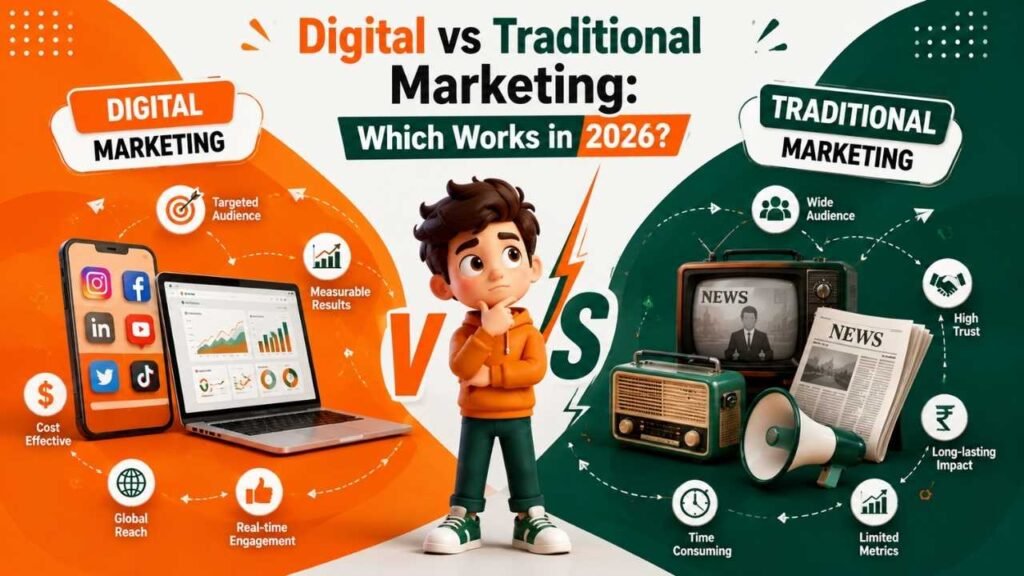
Most articles on this question are written by digital marketing companies, and they all reach the same conclusion. Traditional is dead, digital wins, call us.
We sell digital marketing, and we do not believe that.
In Arrah, Buxar, Patna and most of Bihar, traditional advertising still moves people. Pamphlets in the newspaper still bring walk-ins. A hoarding on the right road still gets seen by thousands of the right people every day. Loudspeaker announcements still fill halls for an event.
The honest answer is that they do different jobs, and a small business should stop asking which is better and start asking which one fits the decision the customer is making.
What traditional still does well
Reaching people who are not online much. A customer over sixty deciding on a hospital, a farmer choosing a tractor dealer, families in villages around your town — some of these people are barely reachable through Instagram. A newspaper insert or a local cable advertisement reaches them.
Establishing that you are real and rooted. A large board outside your premises does something an ad never can. It says you are established, you are not going anywhere, and you were confident enough to pay for that space. In smaller towns this counts for a lot.
Concentrated local reach. A hoarding at a busy crossing hits the same people repeatedly, day after day. For a business whose customers all come from within five kilometres, that repetition builds familiarity efficiently.
Events and moments. Festivals, exhibitions, school functions, sponsorships. Being physically present and visible at a local gathering builds trust faster than any campaign.
Where traditional falls short
You cannot tell what worked. This is the real problem, bigger than cost. You print five thousand pamphlets, sales rise a little, and you never learn whether the pamphlets did it or the festival did. So next year you guess again.
You pay for everyone, not for buyers. A newspaper ad reaches every reader. If you are a dentist, most of them do not need a dentist today.
You cannot change it once it is out. A printed rate that becomes wrong is wrong for as long as the pamphlets circulate. An online ad is edited in two minutes.
It cannot follow up. Someone sees your hoarding, thinks “I should call them”, and forgets by evening. There is no way to reach that person again.
Where digital genuinely wins
Catching people at the moment of need. This is the big one. Somebody with a toothache at 9 PM searches for a dentist near them. No hoarding can be there at that moment. Your Google listing can.
You can measure it. Not perfectly, but well enough to decide. Which ad brought the call, what an enquiry cost, which service page people actually read. That data is what lets you spend more on what works instead of repeating the whole budget blindly.
You can start small. A newspaper ad has a fixed price. Online, you can spend a few thousand rupees, see what happens, and stop. For a small business testing an idea, that difference matters more than the cost per view.
It reaches people again. Someone who visited your website and did not enquire can be shown your ad next week. That second and third touch is where a lot of considered purchases actually close.
Where digital is oversold
Some honesty in the other direction, since we are the ones selling it.
It is not free. “Organic reach” costs time, and time is the scarcest thing a business owner has. Social media that actually works is a monthly commitment, not a weekend project.
Results are not instant. Ads can be, but local SEO takes 60 to 90 days. Anyone promising fast rankings is describing ads or lying.
Cheap clicks are not cheap customers. An agency showing you thousands of impressions for a small budget is showing you the easy metric. Ask what an enquiry cost, and the picture usually changes.
Your customers may not be there. If you sell agricultural equipment to farmers over fifty in surrounding villages, Instagram is not where the decision happens. Be honest about who you actually sell to.
A fair comparison
- Cost to start: traditional needs a fixed minimum — a print run, a board, a slot. Digital can begin with a few thousand rupees.
- Targeting: traditional targets a place. Digital targets a place, an age, an interest, and a behaviour.
- Measurement: traditional is nearly impossible to attribute. Digital is measurable if it is set up properly — and useless if it is not.
- Speed of change: traditional is fixed once printed. Digital changes in minutes.
- Trust and permanence: traditional signals stability and rootedness. Digital signals activity and availability.
- Follow-up: traditional cannot. Digital can, cheaply.
So which should you actually pick?
Match the channel to how your customer decides.
Urgent needs — a plumber, an emergency clinic, an AC repair. Digital, almost entirely. People search at the moment of the problem, and whoever appears gets the call.
Considered, high-value decisions — a hospital, a school admission, property, a wedding venue. Both. People see you locally, then research you online before committing. If they cannot find you online after seeing your board, the board is wasted.
Impulse and footfall — restaurants, retail, salons. Digital for discovery and reviews, traditional for the immediate neighbourhood. Google reviews decide more restaurant visits now than any hoarding.
Older or rural customers — traditional carries more weight, but do not skip the Google listing. Their children look you up on their behalf, and that search decides a great deal.
The mistake that wastes both budgets
Running them as separate things.
A business prints pamphlets with a phone number and no website. Someone reads it, wants to check whether the place is any good, searches the name, and finds nothing. The pamphlet worked and the sale still did not happen.
The reverse also happens: money spent on ads while the shop board is faded and the premises look shut.
Traditional creates awareness. Digital catches it. Every hoarding, pamphlet and board should send people somewhere that confirms what it promised — which for most local businesses means a complete Google listing with photos and reviews, more than a website.
Frequently asked questions
Is traditional marketing dead?
No. It is worse at measurement and targeting, which is a serious disadvantage, but it still reaches people digital struggles to reach and it still signals permanence. What is dead is relying on it alone.
What split should I use?
There is no universal ratio. Start by fixing the free digital foundation — your Google listing costs nothing. Then put paid money wherever your customers actually make the decision. Review it every quarter with real numbers rather than habit.
Which is cheaper?
Digital is cheaper to start and easier to stop. Whether it is cheaper per customer depends entirely on execution — a badly run campaign is more expensive than a well-placed hoarding.
Do pamphlets still work in Bihar?
For some businesses, yes — particularly for openings, offers and events in a defined area. The problem is not that they fail; it is that you cannot tell how well they worked. Add a distinct phone number or a QR code and at least you will know.
I have a small budget. Where do I start?
The free work first: Google listing, categories, services, photos, reviews. It costs time, not money, and for most local businesses it produces more than the first few thousand rupees of advertising would.
The short version
Traditional marketing tells people you exist. Digital marketing is there when they act on it. A small business that does one without the other pays for half a result.
If you are already spending on traditional and wondering what the digital half should look like, tell us your business and city. We will look at where you currently stand and say honestly what would help first — sometimes that is a better shop board, not an ad campaign. You can also see what we handle.