
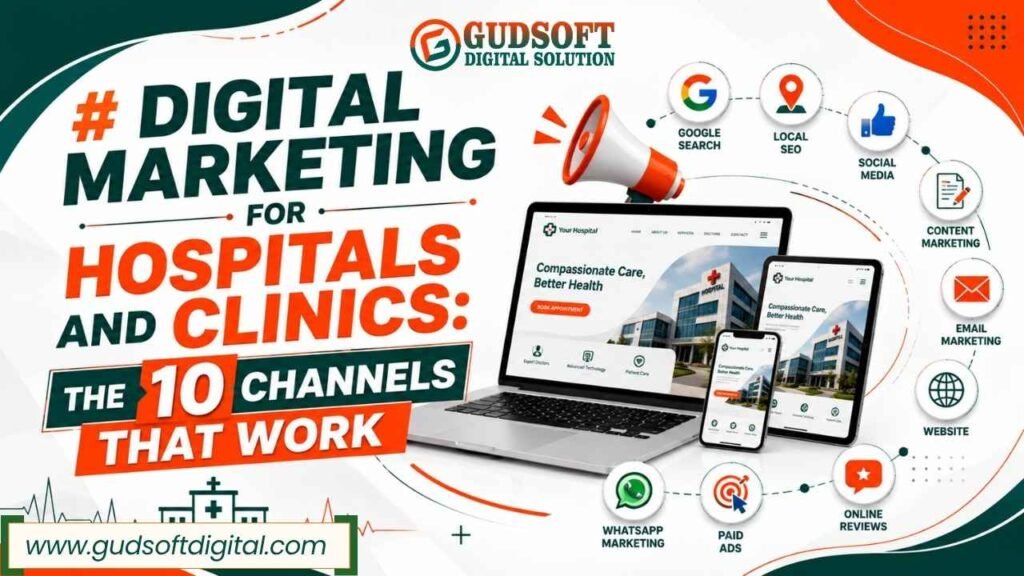
A patient with chest pain at eleven at night does not open Instagram. They search, they look at three listings, and they call whichever one looks open, close and credible.
That moment is what hospital digital marketing is really for. Everything else — the content calendar, the awareness posts, the campaigns — is scaffolding around it.
This guide covers the channels that bring new patients to a hospital or clinic, in the order they are worth doing. If you are more concerned with keeping the patients you already have, that is a different job and we cover it separately in hospital marketing strategies.
1. Your Google listing, before anything else
For a hospital, the Google Business Profile brings more calls than the website does. It shows your rating, distance, whether you are open now, photos of the place, and a call button — everything a worried family needs before dialling.
Three things matter most on it:
- The primary category. The biggest ranking lever you control. A cardiology-focused hospital listed under the generic “Hospital” competes with every hospital in the district instead of owning a narrower category with far fewer rivals.
- Every department listed as a service. Each one you leave out is a search you cannot appear for.
- Photos, updated monthly. Reception, waiting area, wards, equipment, doctors. These answer the question nobody asks aloud: is this place clean?
Details are in our guide to GMB management.
2. Local SEO, so you appear across the district
Patients travel to hospitals. Someone in a village forty kilometres away searching “best hospital for delivery near me” should find you — and distance works against you at that range.
The work that closes that gap is unglamorous: consistent name, address and phone number everywhere online, a separate page for each department, area pages for the towns you draw patients from, and a steady flow of reviews.
This is also the slowest channel. Expect 60 to 90 days before clear movement, then compounding. Our local SEO service covers it with rank grid reporting so you can see where you appear across the whole district rather than just from inside your own building.
3. A website that answers real questions
Hospital websites tend to be built around the institution — history, vision, chairman’s message. Patients want none of that first.
They want: which doctor sits when, what a procedure costs roughly, whether their insurance is accepted, where to park, and what the ward looks like. Build those pages and the site starts producing enquiries.
Two technical points that matter more for hospitals than most businesses: the site must load fast on weak mobile data, and the phone number must be tappable on every screen. A family in distress will not hunt for a contact page.
4. Google Ads for urgent departments
Ads suit anything with immediate need — emergency, trauma, dialysis, diagnostics, a specialist consultation someone was referred for today.
They suit planned procedures less well, because those decisions take weeks and involve family discussion. Running the same campaign for both wastes money on the second.
Call-only campaigns work particularly well here: the ad is the phone number, one tap and your reception rings, no website visit in between. Budget starts from around ₹5,000 a month, paid directly to Google. Our Google Ads service covers the setup and weekly management.
5. Meta ads for planned treatment
Facebook and Instagram reach people who are not searching yet — which is exactly right for planned procedures, health camps, new department launches and awareness around a condition.
Click-to-WhatsApp campaigns are the strongest format in Bihar. Someone taps the ad and a chat opens with your reception. No form, no landing page, no drop-off.
One caution: healthcare is a restricted category. Before-and-after images, outcome claims and copy that names a condition personally are the common reasons hospital ad accounts get restricted. Compliance is not a formality here.
6. Social media that builds trust, not reach
Social will not make you findable. What it does is answer the trust question after someone has found you.
The content that works for hospitals is narrower than most agencies suggest: doctor introductions, facility highlights, health awareness around seasonal illness and health days, OPD schedule updates, and patient journeys shared with written consent.
What does not work: stock photos of smiling models, generic health tips copied from elsewhere, and anything that reads as a claim. See our hospital social media page for how we structure it.
7. Video, because faces build trust faster than text
A ninety-second clip of a doctor explaining what a procedure involves does more than a page of website copy. Patients are choosing a person as much as an institution.
Phone footage in good light is entirely sufficient. What matters is subtitles — most people watch on mute — and keeping it short.
8. A virtual tour, for the question nobody asks
Families travelling from another district want to know the place is clean and well equipped before they set out. Six staged photos do not settle that; a walkthrough does, because it cannot hide what was not photographed.
It also reduces pointless visits — people decide beforehand. See our 360° virtual tour service.
9. Reviews, and how you reply to them
For healthcare, reviews carry more weight than in almost any other category, and recency counts. Eight reviews this quarter beat forty from three years ago.
The system that works is asking at the right moment — at discharge, after a successful consultation — with a QR code and one sentence from your staff.
Reply to every review, including the difficult ones. Never share patient details in a public reply, even to correct an unfair claim. A calm, general response protects both privacy and reputation; an argumentative one damages both.
10. WhatsApp, where the conversation actually happens
Appointment confirmations, report delivery, follow-up reminders and OPD schedule changes all work better on WhatsApp than on phone calls your reception has to make.
Keep it opt-in and keep patient information out of broadcast messages. Our WhatsApp marketing service covers the compliant setup.
The order that matters
If you do only three of these, do the Google listing, the reviews system, and a website that answers real questions. Those three cost the least and produce the most.
Ads are worth adding once tracking works and someone answers enquiries quickly. Social and video are worth adding once the first three are in place. Nothing on this list rescues a hospital where the phone rings unanswered.
Frequently asked questions
Which channel brings hospital patients fastest?
Google Ads, usually within the first week, because it reaches people searching right now. The Google listing often produces more calls overall, but takes a few weeks of work first.
Can we advertise treatments and results?
Carefully. Outcome guarantees and before-and-after images are the most common reasons healthcare ad accounts get restricted. Content built around facilities, doctors, awareness and process performs better anyway, because it reads as information rather than advertising.
Do we need patient consent to post their story?
Yes, in writing, and it is worth keeping that record. Even with consent, avoid anything that identifies a condition alongside a face unless the patient has clearly agreed to that specific use.
How much should a hospital budget for digital marketing?
Start with the free foundation — listing, reviews, service pages. Add paid channels once you can measure what an enquiry costs. Our pricing page shows plan costs with ad budget listed separately.
Who should own our accounts?
The hospital, always. Google Business Profile, ad accounts, social pages and the website should be in your name, with an agency working inside them as a manager.
How long before we see results?
Ads bring enquiries in days. Listing and local SEO work shows clear movement in 60 to 90 days and compounds after that. Anyone promising a fixed ranking by a fixed date is guessing.
Where to start
Open your Google listing on a phone and look at it the way a worried family would at eleven at night. Are the timings right? Is the emergency number tappable? Do the photos show the place or just the building?
If you would rather have it reviewed properly, send us your hospital name and city. We will check your listing, your site and what patients see when they search you, and send back a prioritised fix list — free either way.